Heavy Work Activities for Parents and Educators
Heavy work activities are short, resistance-based movements that give children strong proprioceptive input — sensory feedback from muscles and joints that helps the nervous system organize itself and supports self-regulation. If your child struggles to sit still, crashes into furniture, or melts down before transitions, these activities can make a real difference. Occupational Therapy (OT) professionals use them as a core strategy, and you can start today with things already in your home.
Try these right now:
Carry a laundry basket from room to room
Do wall push-ups (hands flat on the wall, 10 reps)
Bear walk or crab walk across the living room floor
Play tug-of-war with a towel or rope
Push a shopping cart or a heavy box across the floor
Jump on a small trampoline or do jumping jacks
Knead bread dough or squeeze a stress ball
Wear a backpack with a few books inside while doing chores
TL;DR: Short, muscle-engaging activities like these give children’s nervous systems the input they need for better focus and calmer transitions throughout the day. For tailored routines, Autism Victory App offers caregiver-focused guidance built around your child’s specific needs.
Table of Contents
What heavy work actually does to the nervous system
How heavy work can change attention, regulation, and motor skills
When to use heavy work and how to spot a child who needs it
Practical activities organized by category and setting
How to tailor activities for ADHD, autism, sensory seekers, and sensory avoiders
Safety, limits, and red flags to watch for
What occupational therapists recommend and what the evidence shows
Key Takeaways
What actually works when you stop overthinking it
Autism Victory App supports caregivers beyond the basics
Useful sources and further reading
What heavy work actually does to the nervous system
The proprioceptive system works like an internal map. It tells the brain where the body is in space, how much force is being used, and how to adjust movement in real time. When a child pushes, pulls, lifts, or carries something with resistance, the muscles and joints send a flood of organized signals to the brain. That input helps the nervous system settle into a more regulated state, which is why a child who was bouncing off the walls five minutes ago can often sit down and focus after carrying groceries in from the car.
Think of it this way: a laundry basket carried down the hall before homework isn’t just a chore. It’s a targeted sensory experience that primes the brain for the seated, focused work that follows. The resistance from the weight activates deep muscle receptors, and that activation improves body awareness and force judgment — the same skills a child needs to write without pressing too hard or close a door without slamming it.
Pro Tip: Keep heavy work sessions short and woven into what you’re already doing. OTs call these “sensory snacks” — brief bursts of proprioceptive input embedded in daily routines rather than set aside as a separate therapy block. Two minutes of wall push-ups before sitting down for dinner counts.
How heavy work can change attention, regulation, and motor skills
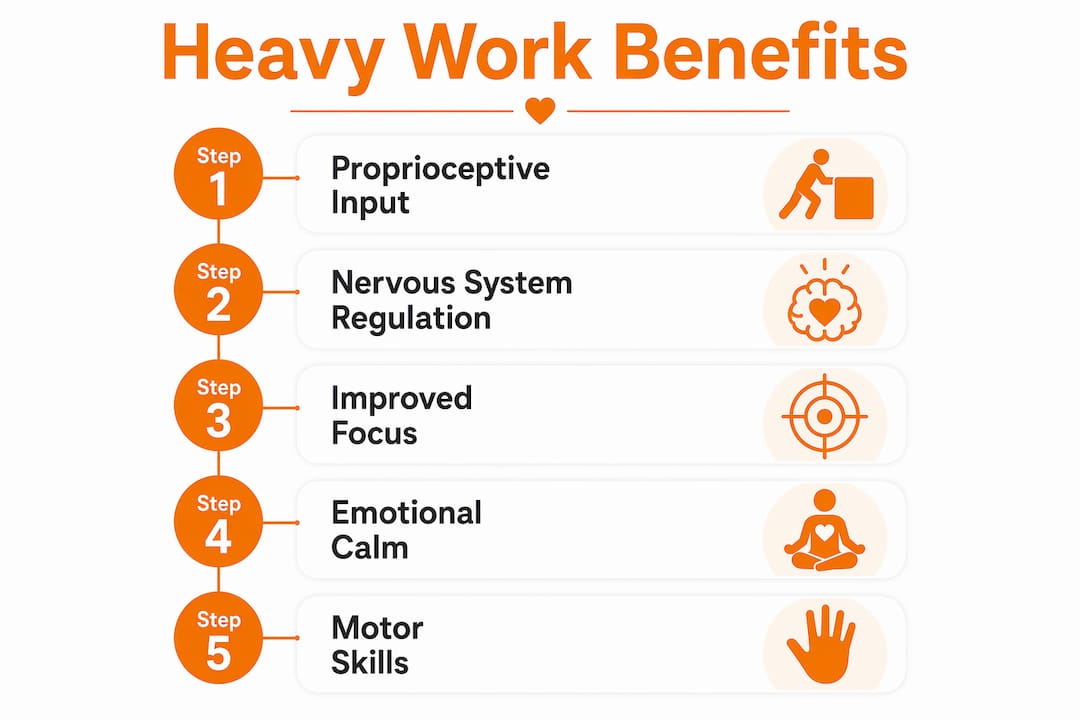
The benefits go well beyond “calming down.” When used consistently, heavy work supports a range of developmental outcomes:
Arousal regulation: Helps children move from an over-excited or under-responsive state into a balanced, alert state where they can engage without unsafe sensory seeking.
Sustained attention: A regulated nervous system is better positioned to stay on task during homework, meals, or classroom instruction.
Motor planning: Repeated resistance activities strengthen the brain’s ability to sequence and coordinate movements.
Core strength and shoulder stability: Activities like animal walks and push-ups build the postural foundation children need for sitting, writing, and fine motor tasks.
Interoception: Regular proprioceptive input improves a child’s awareness of internal body signals, including hunger, fatigue, and emotional states.
One thing worth clarifying: “calming” doesn’t mean a child becomes quiet or motionless. Effective regulation produces a balanced, alert state — a child who can engage, respond, and participate without escalating into unsafe behaviors. That’s the goal.
Realistic expectations: Regulatory benefits often emerge 20–30 minutes after activity, not immediately. Use heavy work proactively — before a transition, not after a meltdown has already started. The effects are most reliable when activities are scheduled consistently rather than used only in crisis moments.
Age also shapes what you’ll see first. Toddlers and preschoolers tend to show the most immediate changes in arousal and mood. School-age children often show gains in attention and task completion over days to weeks of consistent use.
When to use heavy work and how to spot a child who needs it
Some children show clear signs that their proprioceptive system is hungry for input. Watch for these patterns:
Crashing into furniture, walls, or other people
Difficulty sitting still for more than a few minutes
Constant fidgeting, rocking, or chewing on clothing or objects
Using too much or too little force (breaking pencils, hugging too hard, not feeling pain normally)
Seeking high-intensity physical experiences like jumping from heights or rough play
Struggling to transition between activities without a meltdown
These behaviors aren’t defiance. They’re often the nervous system’s attempt to get the input it needs.
Suggested routine slots: OTs recommend scheduling brief heavy work before expected sedentary periods — before homework, meals, car rides, and classroom transitions. A five-minute session before sitting down to read is more effective than trying to calm a child who is already dysregulated.
Think in terms of sensory snacks throughout the day: a set of animal walks before breakfast, wall push-ups before getting in the car, carrying a bag of groceries before dinner. Short and frequent beats long and occasional.
Session length depends on the child and the activity, but most OT guidance points to 5–15 minutes as a practical range for a single session. Effects can last 20–30 minutes after the activity ends, so timing matters. If heavy work alone isn’t producing any change after two weeks of consistent use, that’s a signal to contact an occupational therapist for a formal sensory assessment.
Practical activities organized by category and setting
The table below gives you a quick reference for choosing activities by type, age, and setting. Detailed notes follow.
Category | Example Activities | Best Age Range | Suggested Duration |
|---|---|---|---|
Pushing | Wall push-ups, pushing a laundry cart, moving furniture | Preschool and up | 5–10 reps or 2–3 min |
Pulling | Tug-of-war, pulling a wagon, resistance band pulls | Toddler and up | 2–5 min |
Lifting/Carrying | Grocery bags, laundry baskets, backpack with books | Toddler and up | 2–5 min |
Jumping/Landing | Trampoline, jumping jacks, hop scotch, jump rope | Preschool and up | 5–10 min |
Animal Walks/Core | Bear walk, crab walk, inchworm, wheelbarrow walk | Toddler and up | 2–5 min |
Chewing/Deep Pressure | Chewy foods, gum, body sock, rolling in a blanket | All ages | As needed |
Outdoor/Multi-muscle | Swimming, climbing, shoveling, raking | School-age | 10–20 min |
Pushing
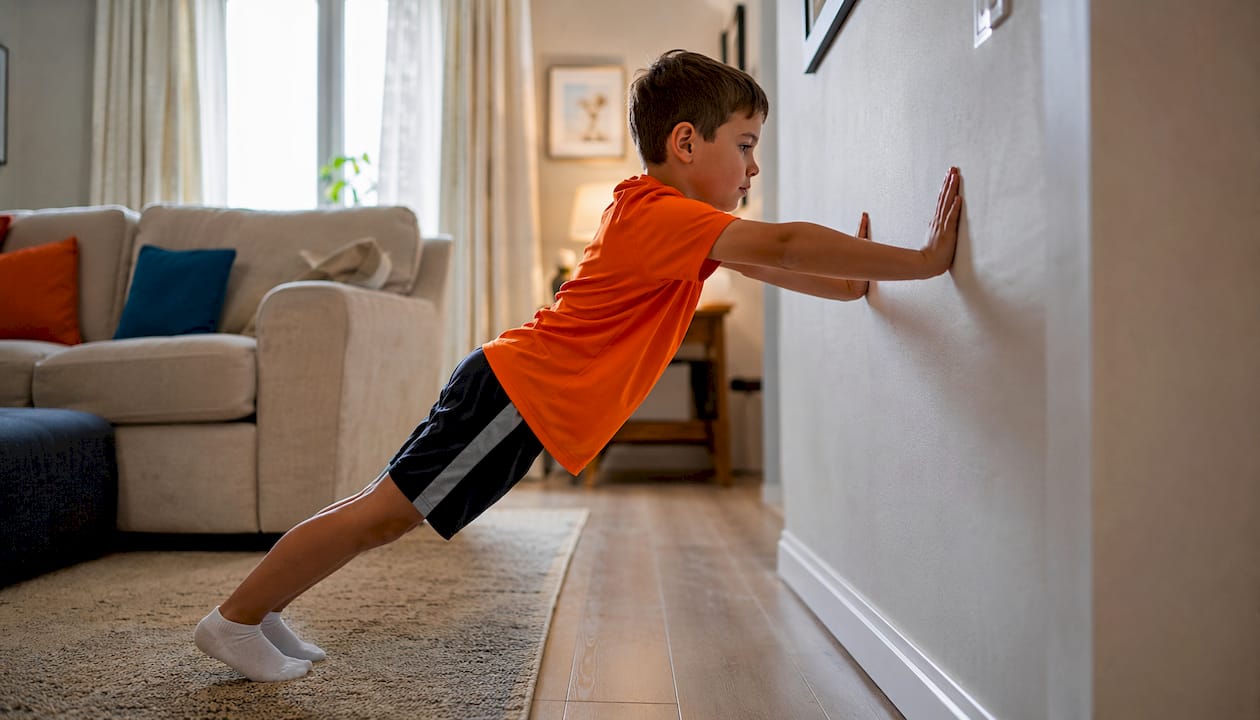
Wall push-ups are the easiest starting point — no equipment, no setup. Have your child place both hands flat on the wall at shoulder height and push for 10 reps. Chair push-ups (hands on the armrests, lifting the body) work well in classrooms. Pushing a heavy box or laundry cart across the floor adds a functional, chore-based option for older children.
Pulling
Tug-of-war with a towel is a favorite because it’s playful and requires no special gear. Pulling a wagon loaded with books or toys works for toddlers. For school-age children, resistance bands anchored to a door handle offer a more structured option. Activities that use many muscle groups at once — like pulling a sled or swimming — are especially effective because they deliver broad proprioceptive input across the whole body.
Lifting and carrying
Carrying grocery bags from the car, moving a laundry basket between rooms, or carrying a backpack with a few books are all practical and easy to build into daily life. For toddlers, scale down to a small bag with one or two items. For school-age children, a backpack with 5–10% of their body weight is a reasonable starting point. The goal is joint and muscle awareness, not muscle fatigue.

Jumping and landing
A small indoor trampoline is one of the most effective tools for children who need frequent proprioceptive input throughout the day. Jumping jacks, hopscotch, and jump rope all work well outdoors. Landing from a jump provides a strong burst of input through the legs and hips. For younger children, jumping from a low step onto a cushion is a safe, controlled version.
Animal walks and core activities
Bear walks (hands and feet on the floor, hips up), crab walks (hands and feet on the floor, belly up), and inchworm walks are all excellent because they load the shoulders, core, and hips simultaneously. Wheelbarrow walking — where a caregiver holds the child’s legs while the child walks on their hands — is a classic OT activity for building upper body strength and motor planning. These work equally well in a living room, a hallway, or a school gym.
Chewing and deep pressure
Chewing on chewy, sugar-free foods like dried fruit, bagels, or gum provides oral proprioceptive input. Rolling a child tightly in a blanket (keeping the head out), using a body sock, or applying firm pressure to the shoulders and back are deep pressure strategies that complement movement-based activities. These are particularly useful for children who are sensory seekers but can’t access movement at a given moment.
Safety note: For jumping activities, always check that the landing surface is stable and clear. For carrying and lifting, use light loads — a few books, not heavy free weights. Supervise animal walks on smooth floors where slipping is possible.
How to tailor activities for ADHD, autism, sensory seekers, and sensory avoiders
Not every child responds the same way, and forcing an activity that feels wrong can increase agitation rather than reduce it. Here’s how to adapt based on your child’s profile.
Children with ADHD tend to respond well to high-energy, movement-rich activities like jumping, animal walks, and tug-of-war. Short bursts (2–3 minutes) before seated tasks work better than longer sessions. Build the activity into a predictable routine so it becomes a cue for what comes next.
Children on the autism spectrum often benefit most when heavy work is embedded in a preferred activity or interest. A child who loves trains might carry a bin of train cars from one room to another. A child who loves cooking can knead dough. Predictability matters: introduce activities gradually and keep the routine consistent. For children who are also working on school accommodations, coordinating heavy work with an IEP or 504 plan can help teachers build sensory breaks into the school day.
Sensory seekers (children who crash, jump, and push constantly) generally tolerate and enjoy most heavy work activities. The priority is channeling that drive into safe, structured options rather than eliminating it. Obstacle courses, climbing, and swimming are good fits.
Sensory avoiders (children who resist physical contact or new movement experiences) need a slower, gentler approach. Start with activities that feel familiar and non-threatening — carrying a light bag, pushing a cart, or doing wall push-ups. Never force a disliked activity. Personalization and patience are what make the difference here.
Dos and don’ts:
Do embed activities into play and daily chores rather than presenting them as therapy exercises.
Do use the child’s interests to make activities feel like fun, not work.
Don’t use heavy free weights with young children — light resistance is all that’s needed for proprioceptive input.
Don’t introduce multiple new activities at once; start with one or two and build from there.
Don’t skip activities on hard days — consistency matters more than perfection.
For children participating in individualized early intervention programs, heavy work can complement structured therapy goals when activities are chosen to match the child’s current developmental level.
Safety, limits, and red flags to watch for
Heavy work is safe for most children when done with appropriate supervision and sensible loads. These guidelines keep it that way.
Safety checklist:
Always supervise young children during jumping, climbing, and animal walk activities.
Use age-appropriate loads — a few books in a backpack, not heavy weights.
Check the environment before starting: clear the floor of obstacles, confirm surfaces are stable.
Watch posture during carrying activities; a child shouldn’t be leaning heavily to one side.
Keep sessions short (5–15 minutes) and avoid pushing through fatigue.
Red flags — stop and consult a professional if you see:
Persistent increase in agitation or distress during or after activities
Complaints of pain in joints or muscles that don’t resolve quickly
Any loss of motor function, coordination, or strength
Changes in breathing that seem out of proportion to the activity
Behavior that doesn’t improve or worsens after two weeks of consistent use
Therapists are clear that heavy weights are unnecessary — the goal is proprioceptive input, not muscle fatigue. A few books in a backpack is often sufficient. Overloading can cause fatigue or increased dysregulation, which is the opposite of what you’re trying to achieve.
Track your child’s responses for one to two weeks — note duration, what you observed before and after, and whether task completion improved — and bring those notes to your next OT appointment.
What occupational therapists recommend and what the evidence shows
OTs who specialize in sensory processing build heavy work into what they call a “sensory diet” — a personalized schedule of sensory activities timed to a child’s daily routine and regulatory needs. The approach is proactive by design.
“Heavy work is most effective when used proactively as short, frequent sensory snacks rather than reactively after a child is at peak dysregulation. OT guidance emphasizes scheduling brief heavy work before transitions to prevent escalation, not to recover from it.” — NAPA Center OT guidance
Key therapist strategies include:
Start small. Introduce one or two activities and observe the response before adding more.
Schedule proactively. Place heavy work before known difficult transitions, not after meltdowns begin.
Use play-based activities. Children engage more consistently when activities feel like games, not exercises.
Involve school staff. Share the child’s sensory diet with teachers so activities can be built into the school day.
Track responses. Simple data — duration of activity, behavior rating before and after, task completion — helps OTs adjust the program.
The evidence base supports the timing principle clearly: regulatory benefits commonly emerge 20–30 minutes after activity, which is why short, frequent sessions outperform single long ones. OTs also emphasize graded exposure — starting with light resistance and increasing only as the child’s tolerance and response indicate it’s appropriate.
Measurement table for sharing with your OT:
Measure | What to track | How often |
|---|---|---|
Activity duration | How long the child engaged | Each session |
Pre-activity behavior | Arousal level, behavior rating | Before each session |
Post-activity behavior | Arousal level, behavior rating | 20–30 min after session |
Task completion | Did the child complete the next seated task? | After each session |
Response trend | Is behavior improving across the week? | Weekly summary |
OTs use this kind of data to identify which activities are most effective for a specific child, adjust timing and duration, and coordinate with families and schools. If you’re new to this process, a first autism diagnosis resource can help you understand how to connect with OT services and what to ask for.
Key Takeaways
Heavy work activities deliver proprioceptive input that helps children regulate, focus, and transition more smoothly when used proactively and consistently as short sensory snacks throughout the day.
Point | Details |
|---|---|
Start with what you have | Carrying laundry, wall push-ups, and tug-of-war require no equipment and work immediately. |
Time it proactively | Schedule heavy work 20–30 minutes before transitions or seated tasks for the strongest effect. |
Keep loads light | Light resistance (a few books, a small bag) is enough; heavy weights are unnecessary and can backfire. |
Track for two weeks | Note pre/post behavior ratings and task completion to identify what works and share with your OT. |
Autism Victory App | Offers caregiver-focused routines, tracking tools, and OT-informed guidance to support your child’s sensory needs. |
What actually works when you stop overthinking it
Here’s the honest truth about heavy work: the families who see the most consistent results aren’t the ones who build elaborate sensory gyms or follow a rigid protocol. They’re the ones who pick two or three activities that fit naturally into what they’re already doing and stick with them.
A child who carries the recycling bin to the curb every evening isn’t doing “therapy.” They’re getting exactly the kind of joint and muscle input their nervous system needs, wrapped in a routine that feels normal and predictable. That predictability is part of what makes it work. The nervous system responds to consistency, not complexity.
The other thing most guides understate: personalization isn’t optional. A child who hates animal walks but loves kneading dough is telling you something useful. Listen to it. Forcing a disliked activity doesn’t just fail to help — it can actively increase resistance to the whole approach. Work with what your child enjoys, and the proprioceptive input will follow. For group settings, group-based physical activities can also build social skills alongside sensory regulation when activities are chosen thoughtfully.
Small, consistent steps add up faster than you’d expect. Two minutes of wall push-ups before homework, a bear walk down the hallway before dinner — those aren’t small things. Over weeks, they reshape how a child’s nervous system responds to daily demands.
Autism Victory App supports caregivers beyond the basics
Knowing which activities to try is a solid start. Knowing how to build them into a routine that actually fits your child’s profile — and your family’s schedule — is where most caregivers get stuck. That’s the gap Autism Victory App is built to close.

Autism Victory App gives you caregiver-focused guidance, routine templates, educational videos, and a community of parents who are navigating the same challenges. The app’s AI-powered tools help you match activities to your child’s sensory profile and track responses over time — so you’re not guessing at what’s working. State-specific resources help you find OT services and funding options in your area.
One important note: Autism Victory App is a caregiver support tool, not a diagnostic platform. It complements in-person OT care — it doesn’t replace it. If your child’s behaviors are escalating or you’re not seeing improvement after consistent effort, an in-person OT evaluation is the right next step.
Start your 7-day free trial at Autism Victory App and get the structured support your family deserves.
Useful sources and further reading
20 Heavy Work Activities for Kids by an OT — NAPA Center: A practical, OT-authored list of activities with explanations of why each one works; excellent starting point for parents and educators.
Heavy Work Activities — Understood: Clear, parent-friendly overview of what heavy work is, why it helps, and household examples you can use immediately.
Heavy Work Handout — UNCG Occupational Therapy Resource: A downloadable OT handout covering activity ideas, timing guidance, and how to recognize when heavy work is helping.
Heavy Work Activities for Preschoolers/Toddlers — Rady Children’s Hospital San Diego (RCHSD): A pediatric hospital PDF with age-appropriate home activities and advice on communicating with your OT about duration and frequency.
Heavy Work Activities — Children’s Wisconsin: A hospital-produced teaching sheet listing games, weighted activities, outdoor options, and deep pressure strategies with clear safety notes.
IEP vs. 504 Plan for Autism — Autism Victory App Blog: Practical guidance on coordinating sensory supports with school accommodations for children with autism.
Recommended